Alexander Jacobsen
Evolutionary Biologist and Naturalist
Previous Work
Emerald ash borer in the tidal swamps of Maryland, USA
Jug Bay Wetlands Sanctuary, Ann Arundel County, MD
Alexander Jacobsen. (2020). Emerald Ash Borer in the Ash (Fraxinus spp.)-Dominated Tidal Swamps of the Lower Patuxent River, Maryland. Northeastern Naturalist, 27(4), Article 4. https://doi.org/10.1656/045.027.0419
Emerald ash borer (Agrilus planipennis, EAB) is one of the most ecologically devastating insects to ever invade North America. I studied its effects on the Ash (Fraxinus) dominated tidal swamp habitat, typical along the tidal rivers in the USA's Mid-Atlantic region, and where the effects of EAB had been previously undocumented. I found that these tidal swamps were especially vulnerable to EAB invasion as compared to the surrounding and more well studied bottomland forest. My results suggested severe structural changes to this habitat were likely to occur, with a transition away from a forested swamp to open scrubland or marsh.
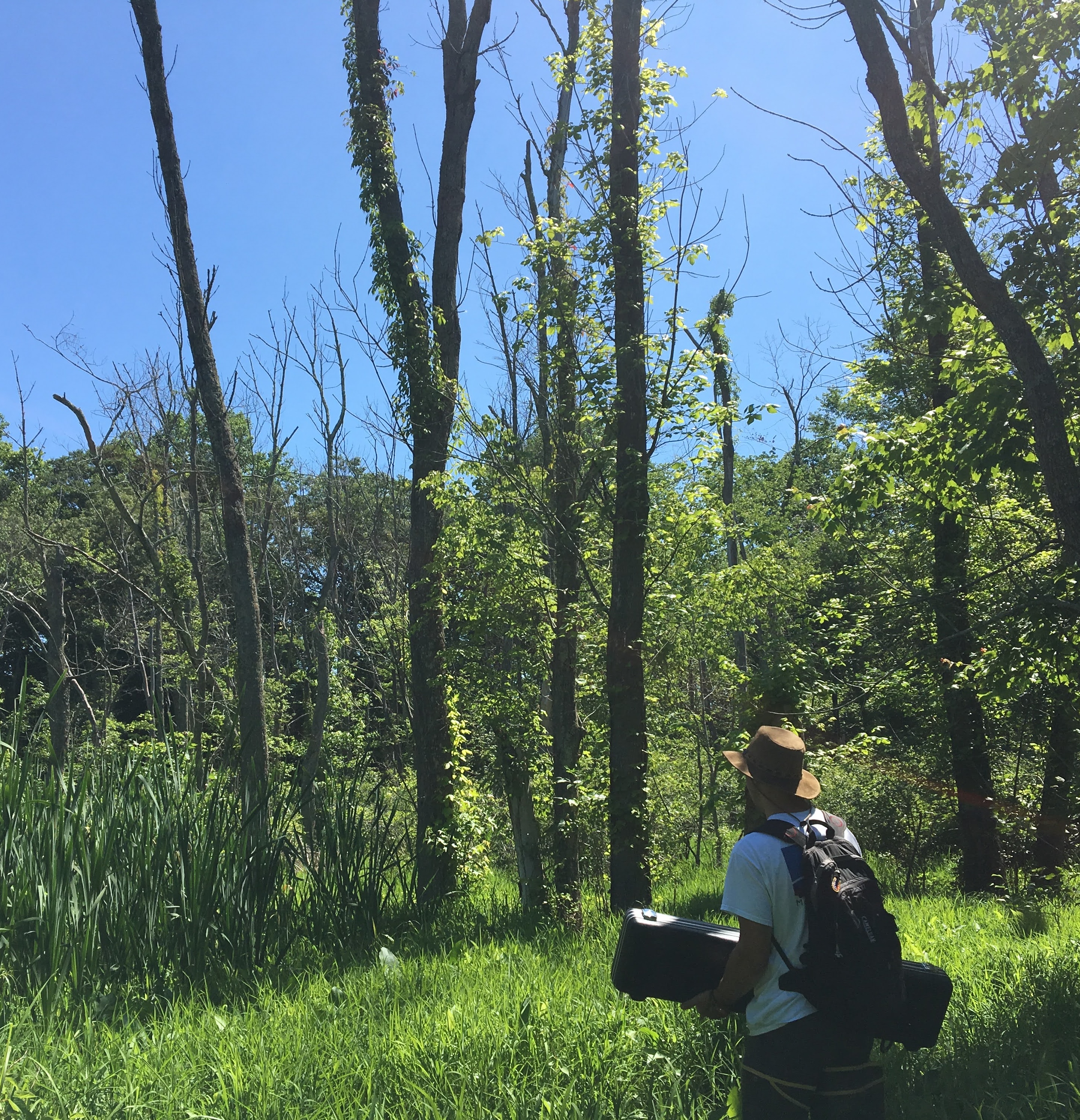
Field work in the Ash-dominated tidal swamp, with nearly all of the canopy removed by Emerald ash borer.
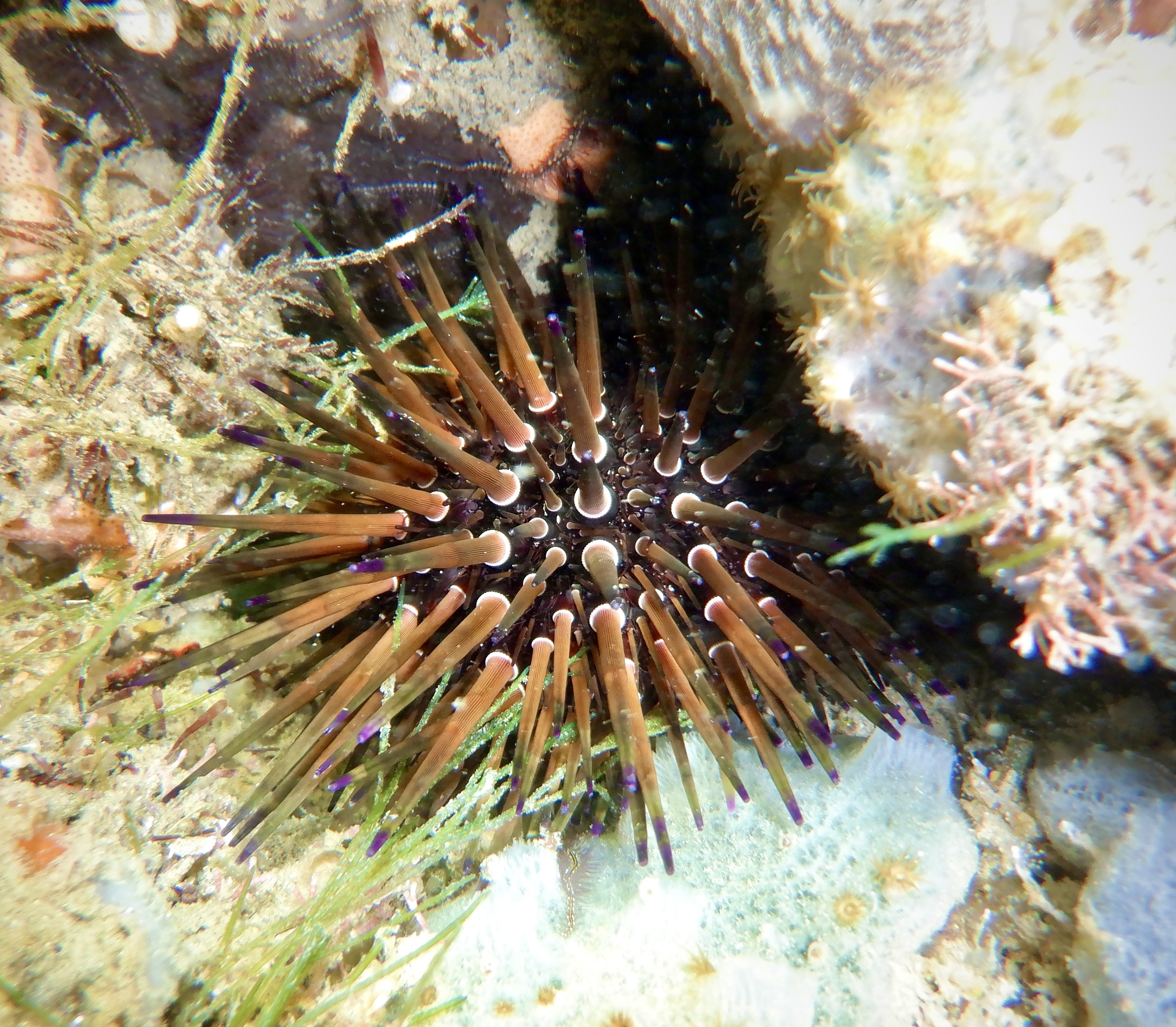
An Echinometra sea urchin on a Panamanian reef in the Carribean.
Barriers to hybridization in Echinometra sea urchins
Smithsonian Tropical Research Institute, Panama City, Panama
Echinometra lucunter and Echinometra viridis are sister species of sea urchin that live in the Carribean sea and have speciated since the closure of the Isthmus of Panama, approx. 3 million years ago. Despite their sympatry and apparent opportunity to hybridize in the wild, hybrid individuals are never found. Working with Dr. Harilaos Lessios, I contributed to a long term study looking for post-zygotic barriers to hybridization between these species. This involved collecting individuals from the wild, crossing them in the lab, and tracking the survivorship of hybrid vs purebred larvae via a genotyping assay.
Sperm selection for captive populations of Przewalski's horse
Smithsonian Conservation Biology Institute, Front Royal, VA
Captive populations of Przewalski's horse can be difficult to manage, due to the aggressive and territorial nature of males. Therefore, a method by which females could be selectively bred is highly sought after. Under the mentorship of Dr. Budhan Pukazhenthi, I tested and quantified the effectiveness of nano-particles intented to bind differentially to sperm based on their sex chromosome content. This was done using fluorescent in-situ hybridization of the sex chromosome.
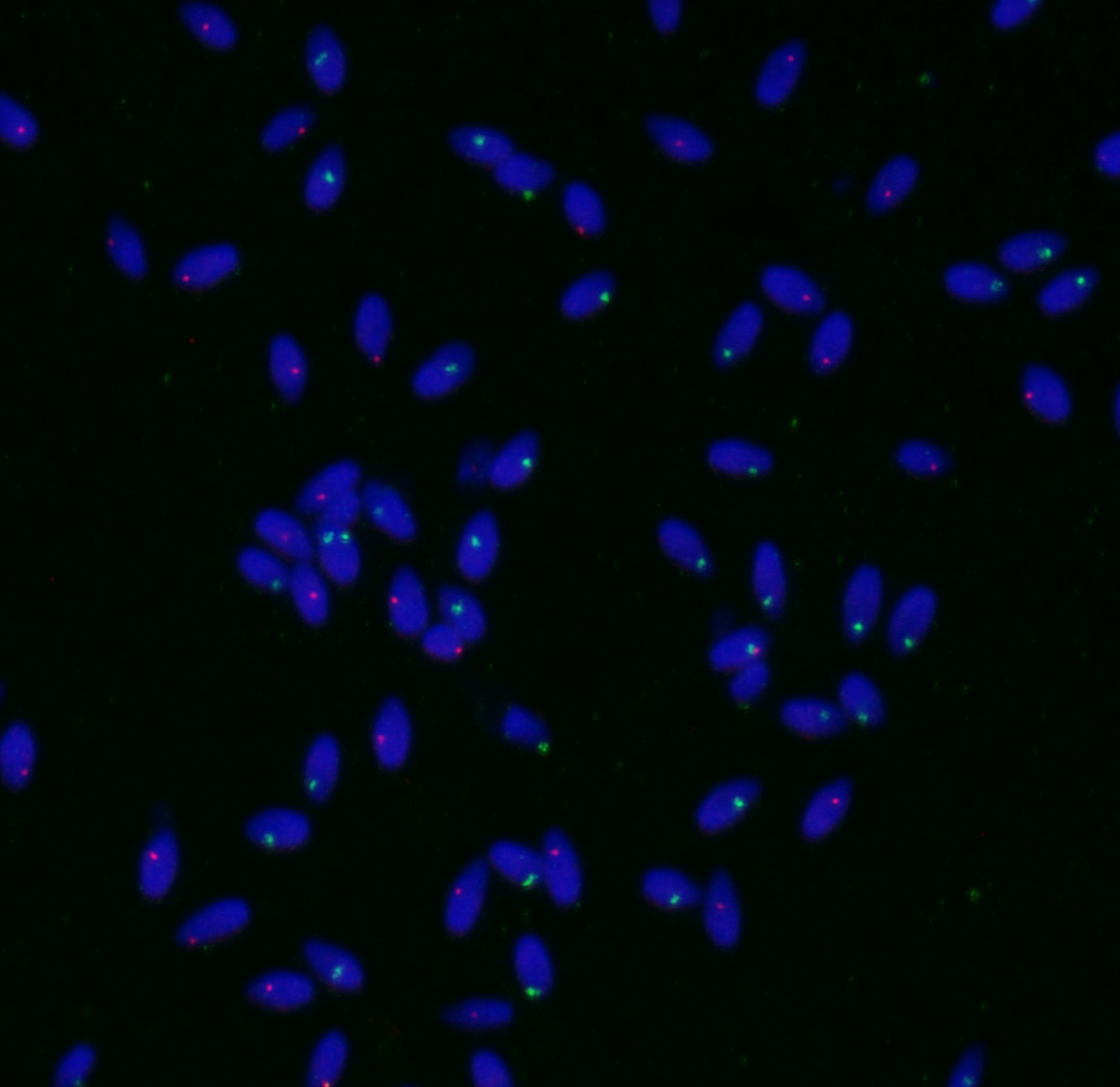
Fluorescent in-situ hybridization of sex chromosomes in Przewalski's horse sperm.